Chapter One – The Table Near the Window
There were restaurants designed to make people forget the world outside, and this was one of them. Beyond the tall windows, the evening city carried the muted silver of recent rain, its pavements reflecting lamps and passing headlights in long broken ribbons. Inside, everything had been arranged to suggest permanence: dark wood paneling polished until it held the light, linen folded with exact precision, glasses thin enough to tremble beneath a fingertip, and candles positioned so that every face appeared slightly kinder than it might have looked beneath daylight.
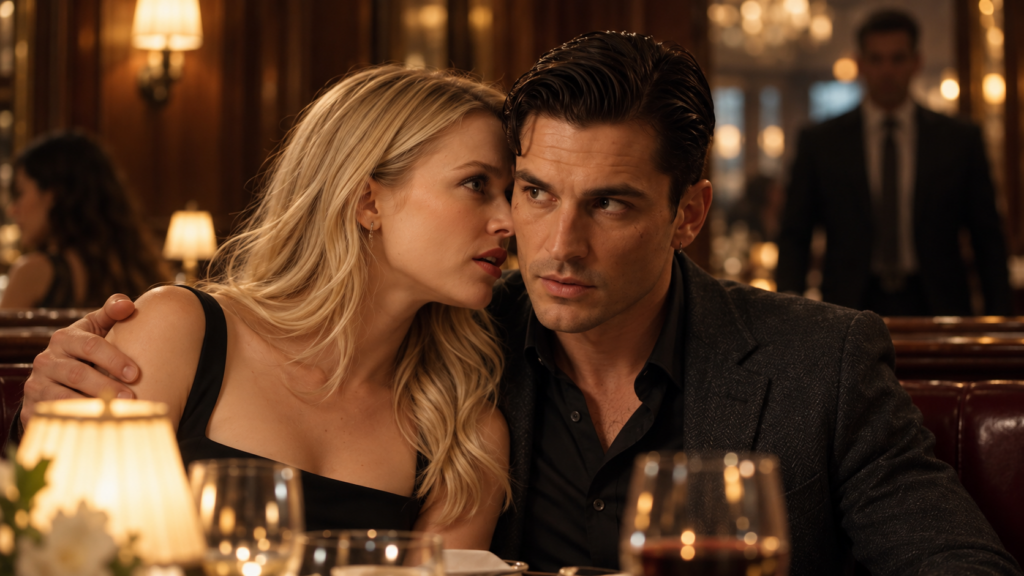
The blonde woman sat in a curved booth beneath a brass wall lamp, wearing a black square-neck dress that made her seem composed in the effortless way of someone who had spent years learning not to reveal discomfort. Her long, wavy hair fell over one shoulder, catching the warm restaurant light in pale strands. Small gold hoop earrings moved whenever she turned her head, and during the first twenty minutes at the table, she turned it often.
She had chosen the restaurant carefully.
That was what made the situation almost absurd.
She knew which entrance offered the shortest walk from the street, which tables were partially hidden by a pillar, which evening hours usually belonged to tourists rather than regular patrons, and even which nights the pianist took his break before nine. She had made all these decisions because she wanted to pass through the evening unnoticed.
Yet some places had memories of their own.
She had once believed elegance could protect people from humiliation. The polished glasses, low voices, expensive coats, and ritual of waiters replacing cutlery after every course had seemed to promise that certain things simply could not happen in such surroundings.
She knew better now.
Across from her sat a man whose calmness was beginning to irritate her only because she desperately wanted some of it for herself.
He wore a dark charcoal blazer over a crisp white shirt left open at the collar, formal enough to belong in the room without appearing to have dressed for approval. His dark hair was parted neatly, though one strand had fallen slightly forward. He had refined features, dark eyes, and the kind of posture that suggested he paid attention even when he appeared relaxed.
He had noticed her distraction.
Of course he had.
He simply had not mentioned it.
They had met by chance through the kind of social arrangement neither of them particularly enjoyed, a dinner gathering that had gradually divided into smaller conversations until, by some accidental choreography, they were left sitting opposite each other. The others had stepped away briefly toward the bar and entrance, leaving them in a pocket of quiet.
At another time, she might have welcomed it.
He was handsome without seeming aware of the fact, and there was something unexpectedly gentle about the way he listened. He did not rush to fill silences. He did not lean closer simply because the candlelight encouraged intimacy. When she spoke, he allowed her words to finish.
For a woman who had once spent nearly three years being interrupted by someone who claimed to love her, this felt dangerous in a different way.
“So,” he said after a moment, lifting his glass but not drinking, “are you always this interested in the entrance?”
She looked back at him.
“Am I?”
“You’ve checked it six times.”
She almost smiled.
“Seven.”
That made him smile first.
For one second, her body loosened.
Then the main door opened.
The movement was ordinary: a waiter stepping aside, cold evening air entering briefly, several people turning their heads.
But she stopped breathing.
She recognized the silhouette before she saw the face clearly.
Her ex.
The man who had taught her that love could become a negotiation conducted in private and a performance conducted in public.
He had not yet seen her.
She lowered her eyes instantly, fingers tightening around the edge of her napkin.
Across the table, the handsome man noticed.
The change in her was subtle enough that most people would have missed it. Her shoulders did not visibly shake. Her expression did not collapse. She did not whisper a curse or reach for her handbag.
Only her fingers betrayed her.
They pressed into the white cloth until the knuckles became pale.
The man set his glass down.
“Is something wrong?”
“No.”
He waited.
She glanced toward the entrance again.
Her ex had removed his coat.
He was moving deeper into the restaurant.
Closer.
“No,” she repeated, quieter this time, as though speaking to herself.
The handsome man’s eyes followed hers without turning his head fully.
He understood enough to know that whatever had entered the room had already been there in her mind.
The blonde woman swallowed.
She could leave.
That would have been sensible.
She could stand, offer an excuse, and disappear through the side corridor before recognition became unavoidable.
But she knew what would happen if she did.
She would spend the entire journey home furious that a man from her past could still choose where she sat, where she looked, when she left a room, and how quickly her heart beat.
Her ex was approaching.
The distance between them was shrinking with every step.
The blonde woman looked across the table at the stranger whose calm presence had, until seconds ago, meant almost nothing in the architecture of her life.
Then she leaned closer.
Her voice barely crossed the candle between them.
“I need you to do something for me.”
The man studied her face.
“What?”
Her ex was close enough now that she could hear his voice somewhere behind the waiter carrying wine.
She leaned nearer still.
And for the first time that evening, fear entered her blue eyes without disguise.
“Pretend you’re my boyfriend.”
The man’s expression changed.
Not dramatically.
Only enough.
He looked at her, then toward the approaching figure, then back again.
And somewhere beneath the soft light, between the white plates and quiet music, the evening ceased to be ordinary.