Chapter Four – Before the Ceremony
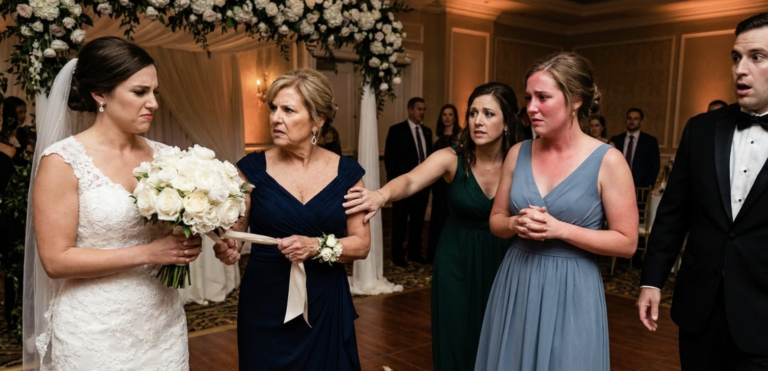
The bride finally sat down.
It was not trust that brought her to the red velvet chair.
It was exhaustion.
The moment her body sank into the seat, she realised how much pain she had been ignoring. Her feet throbbed. Her soaked dress had become heavy enough to pull at her waist. Wet strands of dark hair clung beneath the veil.
The stranger sat opposite her.
Not beside her.
She noticed that.
A small distance remained between them, the width of a low table bearing the untouched water.
It made speaking easier.
“What did you hear?” he asked.
She looked up sharply.
“I didn’t say I heard anything.”
“You ran from your own wedding without your coat, handbag, or apparently one shoe clasp. You didn’t plan to leave.”
She looked down.
He was right.
The stranger continued more gently.
“You heard something.”
For several seconds she watched the chandelier reflected in the water glass.
Then she said, “There was a delay before the ceremony.”
“How long?”
“Twenty minutes.”
“Why?”
“I was told there was a problem with one of the documents.”
His eyebrows tightened.
“What document?”
“They didn’t say.”
“And you believed that?”
“At first.”
Her voice grew quieter.
“I went looking for him.”
The stranger waited.
She described the corridor.
The old building where the wedding was being held.
The doors.
The voices.
Her fiancé speaking in a tone she had rarely heard: stripped of charm, impatient, almost cold.
“I heard him say, ‘She doesn’t need to know until afterward.’”
The man’s gaze sharpened.
“What was he talking about?”
“I don’t know.”
“Anything else?”
She hesitated.
“Yes.”
“What?”
“A name.”
The stranger leaned forward slightly.
She said the name.
His expression changed.
The bride saw it immediately.
“You know that person too.”
He looked toward the bar.
“Yes.”
“Who is he?”
“An attorney.”
Her mouth went dry.
“For my fiancé?”
“Sometimes.”
“What kind of attorney?”
“Commercial disputes. Contracts. Asset structures.”
She stared at him.
The room suddenly seemed unbearably warm.
“What could that possibly have to do with me?”
“I don’t know.”
“You keep saying that.”
“Because guessing would be worse.”
She looked at him angrily.
“You already know enough to destroy half of what I believed this morning.”
His face tightened.
“I know.”
She stood again too quickly.
The room shifted.
Her hand caught the edge of the chair.
The stranger moved instinctively, but stopped before touching her.
“Sit.”
“I’m fine.”
“You nearly fell.”
“I said I’m fine.”
He stepped back.
The bride noticed.
No grabbing.
No insisting.
No hand at her waist under the excuse of helping.
It was strange how much such restraint mattered after months spent with a man who often disguised decisions as care.
Her fiancé had selected the wedding venue because she would “thank him later.”
He had changed the guest arrangements because he “knew what would be easier.”
He had asked her to leave work early more often because there was “no point exhausting herself.”
None of it had seemed alarming individually.
Taken together, the memories now formed a pattern she did not yet want to name.
The stranger watched her carefully.
“You don’t have to tell me anything else.”
She laughed without humour.
“That’s generous.”
“It isn’t generosity.”
“What is it?”
“Experience.”
She looked at him.
“With him?”
The question landed between them.
The stranger lowered his gaze.
“Yes.”
The bride slowly sat again.
“What did he do to you?”
The man rubbed one hand across his jaw.
“It’s complicated.”
“That’s what dishonest people say when they want more time.”
He looked at her.
A faint, reluctant smile touched his mouth.
“You’re not wrong.”
“Then simplify it.”
He thought for a moment.
“We built something together. I believed we were partners. I discovered later that he had been moving agreements, obligations, and information around without telling me.”
“Did he steal from you?”
“Not exactly.”
“Was it legal?”
“Mostly.”
“That sounds worse.”
“It felt worse.”
The bride stared at him.
“Why didn’t you warn people?”
“Which people?”
“Women. Business partners. Anyone.”
He looked at her steadily.
“Because knowing someone behaved badly with me does not give me the right to define every relationship they have afterward.”
She hated how reasonable the answer was.
It prevented her from turning him into a convenient hero.
“Until tonight,” she said.
“Until I recognised the ring.”
Silence returned.
The bride looked at the diamond again.
For the first time she considered taking it off.
Her fingers moved toward it.
Then stopped.
The stranger noticed but said nothing.
That silence, more than any instruction, allowed her to breathe.