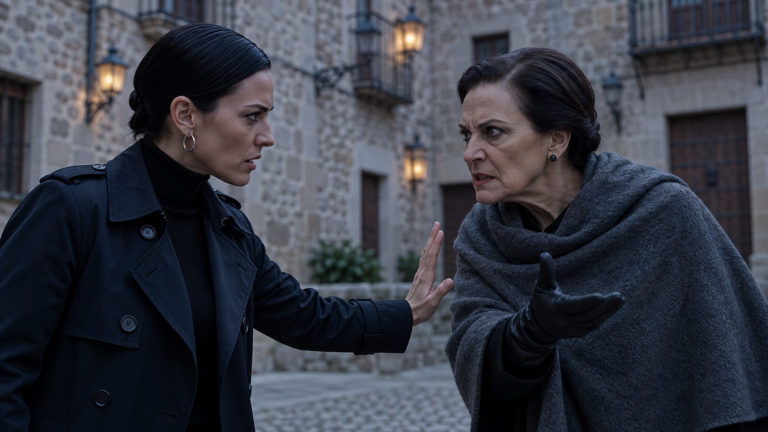
Chapter Six – The Door He Could Not Touch
He reached the porch.
His hand rose toward the handle.
Then stopped.
A few centimetres separated his fingers from the brass.
He stood like that, frozen beneath the warm light, breath shallow, one shoulder slightly raised from the tension of running.
The door had once opened for him hundreds of times.
He had carried groceries through it.
He had stood beneath its frame while shaking rain from his jacket.
He had leaned against it during arguments, unwilling to leave and too proud to stay.
Now touching it felt like crossing a border.
He lowered his hand.
The house was silent.
No voices reached him from within.
No footsteps crossed the floor.
Yet a faint lamp burned deeper inside, visible through the slim window beside the door.
He looked at that rectangle of light and thought of the paper behind him.
The document could answer the question that had consumed years of his life.
It could also destroy whatever explanation he had built in its absence.
People often imagined that uncertainty was unbearable.
He had discovered the opposite.
Uncertainty could become a shelter.
It allowed hope and resentment to survive together.
Truth chose one.
He turned his head slightly.
From the porch he could see only part of the driveway.
The bins stood beyond the parked car.
The flashlight remained aimed toward the ground.
Whoever held it had still not followed.
His throat tightened.
He understood then that returning to the paper would require a second decision.
Coming to the house had been desperation.
Going back would be choice.
And choice was harder.
Chapter Seven – What Guilt Looks Like from a Distance
For three years, he had told himself he was innocent.
Not innocent of mistakes.
No adult had that luxury.
But innocent of the thing that ended everything.
There had been accusations he did not understand, conversations stopped when he entered rooms, and eventually a departure delivered with such cold restraint that anger would have been easier to survive.
He remembered asking what he had done.
The answer had been silence.
Later, he became angry enough to create answers of his own.
Someone had lied about him.
Someone had used him.
Someone had wanted him gone.
Those explanations hardened into certainty because certainty was easier to live with than the possibility that he had forgotten something essential.
Then came the photograph.
His name.
That date.
The handwriting.
The paper now lying beside the bin.
For the first time, another possibility had emerged.
What if the document did not prove someone else had betrayed him?
What if it proved someone had protected him?
The thought struck with almost physical force.
He leaned against the porch rail.
From there, the man in the black hoodie no longer looked like a suspect fleeing a property.
He looked tired.
Young in a way that only exhausted adults sometimes do.
The hood shadowed his face, but his posture had lost its urgency.
He had reached safety and discovered he did not know what safety meant.
Behind him, the paper waited.
Ahead of him, the house contained whatever remained of the life from which he had been excluded.
The space between those two points was only a driveway.
Emotionally, it was three years long.